Renewable Development Is Struggling With Execution
By Patrick Woods ·
If you look at the renewable energy market right now, it’s hard to argue there’s a shortage of opportunity. Demand is rising, capital is available, and development pipelines are as full as they’ve ever been.
Yet, more activity hasn’t translated into more completed projects. According to the Lawrence Berkeley National Laboratory, only ~13% of projects that entered U.S. interconnection queues between 2000 and 2019 have reached commercial operation.

Most of the pipeline never gets built.
Source: Lawrence Berkeley National Laboratory
Pipeline size isn’t the issue. And neither is project complexity. Renewable development has never been a linear process. Land, interconnection, permitting, financing, and offtake have always influenced one another, and experienced developers have always understood how tightly coupled those decisions really are.
What’s changing is the rate and intensity at which those dependencies move. Interconnection studies are revised more often, with larger cost swings. Permitting requirements shift as upgrade assumptions evolve. Capital markets and offtake terms move on shorter cycles.
The old way of managing complexity through coordination — review meetings, spreadsheets, shared models, institutional knowledge, and teams constantly reconciling changes — can’t keep up with how quickly assumptions, constraints, and timelines now evolve. What many developers are learning is that coordination alone is no longer enough to maintain execution at scale. As projects move faster and dependencies become more tightly coupled, the real challenge is keeping every decision across the project aligned.
What many developers are learning is that coordination alone is no longer enough to maintain execution at scale.
The Danger of Hidden Decision Misalignment
When projects fail, it’s easy to blame it on a single task that stalled or a team missing an important step. But this simplified narrative rarely fits the reality. More often, projects fail because decisions gradually fall out of alignment — and nobody fully realizes it until the consequences become prohibitively expensive.
- Offtake discussions continue advancing based on assumptions that don’t reflect the latest project designs.
- Permitting work moves forward under an original scope, even as evolving community feedback begins reshaping what that scope should include.
- Financing models continue reflecting timelines and cost structures that no longer match the project.
None of this necessarily looks like failure in real time. From the outside, the project may appear to be moving normally: meetings are happening, milestones are being hit, and teams are executing against the information in front of them.
That drift is dangerous precisely because it’s difficult to see while it’s unfolding. By the time the misalignment fully surfaces — as a financial model that no longer pencils, a permit pathway that no longer fits, or a project timeline that can no longer hold — the cheapest and most flexible correction paths are often already gone.
At that point, different teams are effectively operating from different versions of reality.
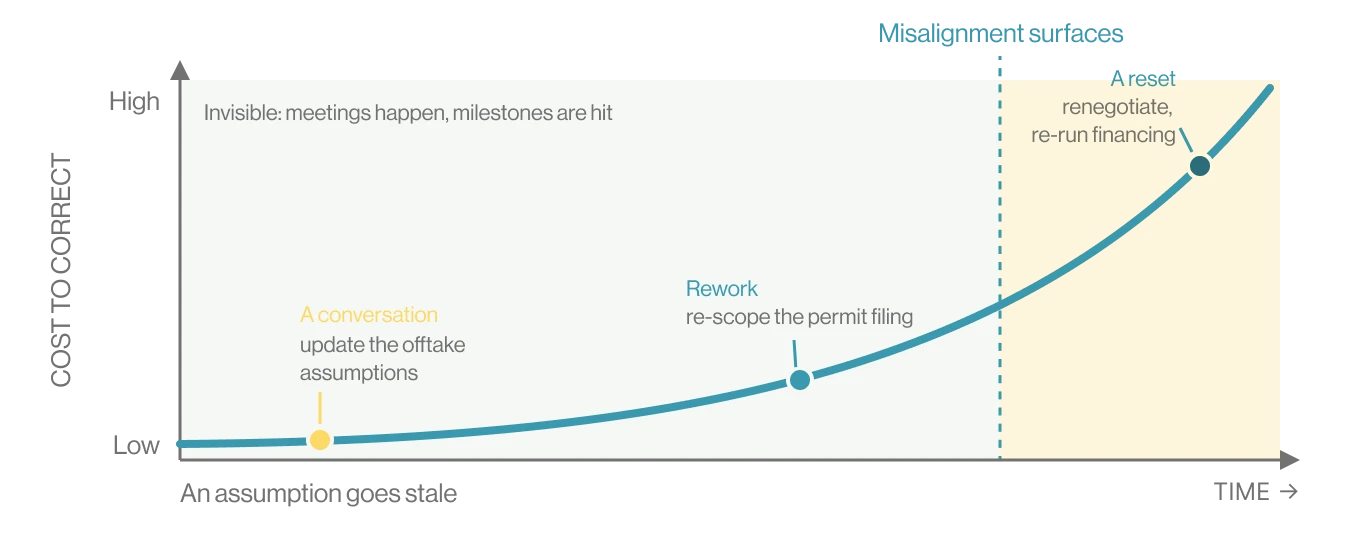
Drift is cheap to fix early and expensive to fix late. The cost of correcting a stale assumption climbs while nobody can see it. By the time it surfaces, the cheapest fixes are gone.
At that point, different teams are effectively operating from different versions of reality.
The Missing Path from Visibility to Execution
At this point, many development teams jump to the most obvious solution: everyone isn’t seeing the whole picture. In other words, visibility is the problem. But most teams have more information at their fingertips than ever before. Dashboards track milestones. Spreadsheets model assumptions. Teams exchange updates across meetings, emails, and development reviews.
The real issue, then, isn’t visibility. It’s coordination — or rather, that coordination systems weren’t designed to continuously keep interconnected decisions in sync at this speed.
Most coordination systems are built to surface updates, not to continuously propagate the implications of those updates across the rest of the project. An updated interconnection study may alter the economics of a site, but the implications don’t automatically ripple through permitting assumptions, financing timelines, land commitments, and portfolio prioritization. A permitting delay may be visible to the permitting team, but not fully reflected in downstream capital planning or upstream development sequencing until much later.
That’s how hidden misalignment persists even inside highly coordinated organizations. Each group sees part of the picture and acts rationally based on the information available to them. But no system is actively keeping teams synchronized across the full set of interconnected decisions.
What’s missing is an execution infrastructure that connects decisions, dependencies, and assumptions across the development lifecycle. In practice, that means:
-
Explicit dependencies
Dependencies between decisions must be explicit rather than held in institutional knowledge or scattered across disconnected models.
-
Automatic propagation
Changes must propagate automatically across the project instead of relying on teams to manually reconcile implications across functions.
-
Assumptions in sync
Assumptions and constraints must be kept in sync so that different groups are not unknowingly executing against conflicting realities.
-
Test before committing
Teams need the ability to evaluate potential changes before committing to them, understanding how revised interconnection costs, permitting timelines, or financing conditions could impact the broader portfolio.
Visibility only shows teams what changed. An execution system helps ensure the rest of the project changes with it.
Synchronized Execution in Practice
The difference between coordination and execution infrastructure shows up most obviously in how projects respond to change.
In a traditional coordination model, updates move manually. Teams communicate changes through meetings, revised spreadsheets, updated forecasts, and follow-up conversations. The larger and faster-moving the portfolio becomes, the harder it is to ensure every downstream implication is identified, reconciled, and reflected everywhere it matters.
Synchronized execution changes that dynamic by continuously connecting decisions, assumptions, and dependencies across the project lifecycle.
When an interconnection study is revised, the impact doesn’t stay isolated to engineering. Financing assumptions, design constraints, land commitments, and portfolio prioritization can all be reevaluated immediately in light of the updated economics. When permitting timelines shift, the implications can propagate across financing models, construction sequencing, and development planning before the delay compounds into a broader reset. When capital markets move, teams can evaluate how revised financing conditions affect project viability and portfolio prioritization before committing capital.
The goal isn’t to eliminate change. Renewable development will always involve evolving constraints, redesigns, and shifting assumptions. The objective is simply to reduce the lag between a change occurring and the rest of the project responding coherently to it.
How Synchronized Execution Changes What AI Can Do
With this structure in place, development teams have a much better foundation for using AI to enhance the work.
Without synchronized execution, AI is largely limited to summarizing information scattered across documents, trackers, and disconnected workflows. It can surface updates, but it still lacks a reliable understanding of how decisions connect or what implications a change creates across the broader project.
But when decisions, dependencies, and assumptions exist within a continuously synchronized execution system, AI gains operational context. Instead of simply reporting information, it can help identify downstream conflicts, surface assumptions that have drifted, evaluate proposed changes against the broader portfolio, and pinpoint risks before misalignment causes serious delays or costly rework.
That transforms AI into something more than a way to accelerate processing project information. With the foundation of execution, AI can actually enhance the way teams stay aligned as projects evolve.
AI on scattered information
- Summarizes documents, trackers and workflows
- Surfaces updates
- Can’t see how decisions connect
AI with operational context
- Identifies downstream conflicts
- Surfaces assumptions that have drifted
- Evaluates proposed changes against the portfolio
- Pinpoints risks before they cause delays/rework
Context turns reporting into reasoning. The same AI does more when it can see how decisions depend on each other.
The Maturity Shift: Systems Replace Coordination
What’s happening in renewable energy project development now isn’t unique. In industry after industry, coordination stops working when scale crosses certain threshold. The response is always the same: build the system that the older mode of coordination was approximating.
- Manufacturing moved from manual coordination to lean systems to reduce variability and waste.
- Cloud computing replaced release coordination with infrastructure-as-code to achieve consistency at scale.
- Financial institutions built real-time risk systems when exposure could no longer be tracked manually.
Renewable development is reaching the same threshold. At scale, the work isn’t about sequencing steps – it’s about keeping decisions coherent across a system where timelines move, dependencies interact, and assumptions are fluid. Coordination fails not from poor communication, but because the system has outgrown what communication alone can manage.
Coordination fails not from poor communication, but because the system has outgrown what communication alone can manage.
Designed Execution Wins
The renewables development industry is at a turning point. Pipelines are full. Demand isn’t in doubt. The question is whether developers can move projects through the system they’ve built without losing alignment along the way.
As timelines compress and decisions become more tightly linked, the margin for drift is shrinking. Pipelines can still create volume, but they can’t keep that volume on track as conditions change. In many ways, successful development has become the art of synchronizing decisions as projects stay in constant motion.
In this environment, execution isn’t a function of effort. It’s a function of design.
In this environment, execution isn’t a function of effort. It’s a function of design.
If your organization is exploring new ways to reduce stakeholder risk, improve coordination, and strengthen project execution, we’d welcome the opportunity to continue the conversation.