Why Timeline Volatility Is Changing Renewable Project Returns
By Varun Gowda ·
Electricity demand is stronger than it’s been in decades, and projects are moving forward in markets that felt dormant just a few years ago. Capital is available. Utilities and hyperscalers are signing contracts. PPA markets have largely absorbed the Inflation Reduction Act, with tax incentives now reflected directly in contract pricing. On the surface, this should be a constructive development environment. Yet, somehow, the assumptions around renewable project development feel more fragile than ever.
Development timelines are stretching under moving study conditions, binary permitting outcomes, and evolving upgrade allocations. Projects are not simply being delayed — they are being re-underwritten mid-cycle. Cost structures get revisited. Security requirements change. Capital commitments are extended. Investor conversations restart.
Projects are not simply being delayed — they are being re-underwritten mid-cycle.
When interconnection, permitting, financing, and construction stop progressing in a stable order, development timelines become unreliable. And when duration becomes a question mark, returns compress — even when the customer demand remains strong. What was once simply a scheduling variable has now become a financial variable.
The upshot? Execution risk is now shaping financial outcomes as much as project capacity or PPA pricing. What follows is a closer look at how sequencing issues show up inside project economics, and why duration sensitivity has become one of the dominant constraints in development today.
Why Duration Is Not Neutral in Project Finance
Time is no longer just a scheduling variable in infrastructure development; it is now embedded directly into how projects are financed and how returns are modeled:
- Equity investors commit capital based on an expected construction timeline and a defined commercial operation date.
- Debt facilities assume a specific draw schedule.
- Tax equity structures depend on when projects enter service.
- And development capital — including interconnection deposits and site control payments — remains exposed for as long as the project remains unbuilt.
Each of those capital investments is tied to duration. And when timelines shift, the assumptions supporting those investments begin to move with them.
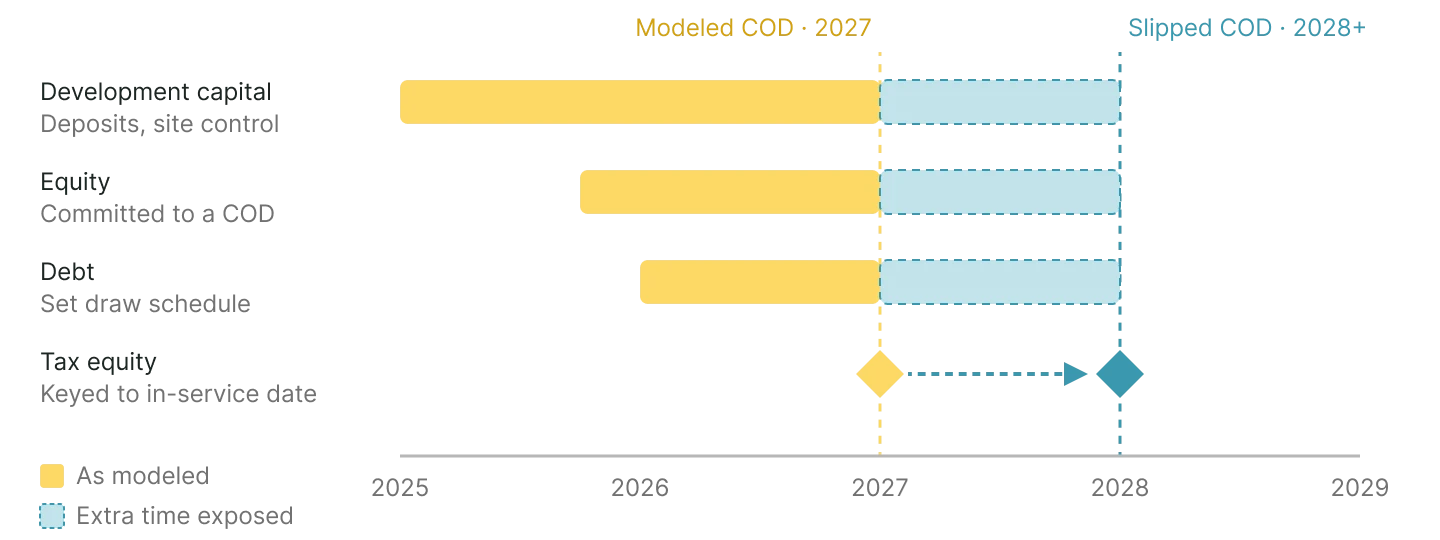
Every capital layer is keyed to the calendar. When the operation date slips all of them move at once.
We see it all the time: A project originally modeled to reach commercial operation in 2027 may slip a year or more as interconnection studies evolve, upgrade allocations change, or permitting timelines extend. Meanwhile, deposits remain posted, development capital stays deployed, and counterparties revisit their pricing assumptions.
These shifts may not kill the project, but they do change the economics of it. Longer development timelines mean capital is locked up for longer, financing assumptions can shift, construction costs may be repriced, and offtake negotiations may need to be revisited. Development teams also face a quieter but equally real cost: capital tied up in slow-moving projects can’t be recycled into the rest of the pipeline.
A project that was modeled at, say, a 12% internal rate of return (IRR) may dip to 9% as timelines extend. It still gets built, sure. But a 3% IRR difference on a multi-million-dollar development represents a significantly different outcome than what was projected.
This is why duration volatility has become so consequential. In project finance, time does not simply delay returns — it constrains them.
In project finance, time does not simply delay returns — it constrains them.
Sequencing Risk: The New Failure Mode
What’s behind this timeline unpredictability? The issue facing developers is that the steps required to bring a project to market are increasingly interdependent. A delay in one area can unravel assumptions across the entire project.
Such tight coupling creates sequencing risk — when the order of development milestones becomes unstable and delays in one area force the entire project to be re-underwritten under new assumptions. This dynamic now shows up in nearly every aspect of project development.
Sequencing risk now appears across several parts of the development process.
Interconnection as Capital Exposure
Interconnection has become one of the clearest examples of this sequencing dynamic. Berkeley Lab estimates that more than 10,000 projects representing roughly 1,400 GW of generation and 890 GW of storage were sitting in U.S. interconnection queues at the end of 2024 — more than twice the capacity currently operating. The median time from interconnection request to operation has doubled from less than two years in 2007 to nearly four years by 2024.
10,000+
projects waiting in U.S. interconnection queues, end of 2024
~2,290 GW
1,400 GW of generation plus 890 GW of storage
2x+
more capacity in the queue than is operating today
A longer line, and a slower one.
Source: Lawrence Berkeley National Laboratory
But the challenge is not simply queue backlogs. In today’s cluster-based interconnection processes, network upgrade costs are often shared across multiple projects within the same study group. As developers decide whether to remain in the queue or withdraw after receiving study results, those choices can shift upgrade allocations across the entire cluster — sometimes transferring millions of dollars of cost exposure onto the projects that remain.
A decade ago, few projects died purely because of interconnection exposure. But in this new cluster-driven environment, upgrade allocations can be larger, more volatile, and more tightly coupled to neighboring projects. What was once a manageable engineering variable has become a capital allocation risk.
Permitting and Community Approval Risk
Permitting timelines have also become less predictable. Larger project footprints and heightened community scrutiny mean local approvals are no longer purely procedural. In some jurisdictions, zoning decisions, land-use approvals, or tax abatements can determine whether a project moves forward at all. This evolving permitting environment requires a larger investment of time (and capital) to cultivate community support, navigate local politics, and establish the foundations for long-term project success. A simple scheduling formality is now a binary go/no-go milestone for development.
Land Sequencing
Land control is often treated as an early development milestone, but in practice it remains exposed throughout the project timeline.
Most utility-scale projects rely on layered option agreements with defined payment schedules and expiration dates. Those agreements are typically structured around an expected development sequence — site control, interconnection studies, permitting, and construction.
When that sequence stretches, the land strategy stretches with it. Option periods must be extended, additional payments may be required, and developers must revisit timelines with landowners who expected the project to move forward sooner. At that point, maintaining land access becomes just as critical as securing permits or interconnection rights.
Capital Repricing During Delay
Project financing assumptions are also time sensitive. Interest rates move, tax equity appetite shifts, and construction costs swell with inflation. A project that remains technically viable may still require its financing structure to be revisited if timelines extend beyond the assumptions laid out in the original underwriting.
When development schedules slip, projects remain exposed to those capital markets for longer than originally planned. Debt spreads can widen, tax equity providers may adjust pricing, and EPC contracts may be renegotiated as construction costs evolve. A straightforward financing plan can turn into a moving target as the development timeline stretches.
Why Execution Feels Different Today
Perhaps you’re still skeptical that this all adds up to a substantially different environment. “Development risks have always existed,” the argument goes. And that’s true. What’s changed is the degree of coupling between these various risks.
A decade ago, demand growth was modest, capital was inexpensive, and development timelines moved more predictably. Projects could absorb setbacks because the surrounding system was relatively stable. When they failed, it was largely because the initial project assumptions were wrong from the outset.
Today, electrification, industrial reshoring, and data center growth are reshaping regional demand forecasts as we speak. Transmission expansion is slower to respond, and capital markets are much more sensitive to duration.
In that environment, delays have a cascading effect. Every assumption change brings ten others with it. And as those changes mount, the options for keeping the project on track become more and more limited.
Development used to be a pipeline. Increasingly, it behaves like a network — where a delay in one node propagates across the entire system.
Development used to be a pipeline. Increasingly, it behaves like a network where a delay in one node propagates across the entire system.
The Hidden Cost: Shrinking Optionality
Now, that brings us to where developers really start to feel the cost: a loss of flexibility.
Historically, development pipelines were built around optionality. Teams maintained large portfolios knowing some projects would fall away, timelines would vary, and capital could be redeployed toward the opportunities that progressed fastest.
When timelines are stable, that flexibility works. Projects can move forward in parallel, capital can be redeployed between opportunities, and delays in one project rarely disrupt the rest of the pipeline.
But when development milestones become tightly coupled, that flexibility starts to disappear:
- Security deposits accumulate across multiple queue positions.
- Permitting outcomes determine whether engineering work can proceed.
- Financing assumptions hinge on interconnection timelines that are still evolving.
Instead of shifting resources between projects, teams often find themselves waiting on a single unresolved milestone. A delay in one project doesn’t just affect that asset. It can ripple across an entire development portfolio.
The Risk Profile Has Changed
The opportunity is real in this energy market. Demand is strong. Capital is available, and utilities and large energy buyers are actively signing contracts.
But the dominant failure mode in development has changed. Projects are not faltering because buyers disappear or technology falls short. They are faltering because sequencing breaks under compressed timelines. In this environment, a project can have strong fundamentals and still struggle if the development sequence begins to unravel. Where development timelines once offered optionality, now they trap it.
Where development timelines once offered optionality, now they trap it.
And here’s what it comes down to: If timeline volatility is now structural, development cannot remain a loosely coordinated set of parallel workstreams. It must become systematized. The next evolution is building systems that manage sequencing across complex development workflows — which is where the conversation turns next.
If your organization is exploring new ways to reduce stakeholder risk, improve coordination, and strengthen project execution, we’d welcome the opportunity to continue the conversation.